Monitoring internal physiological signals is essential for effective medical care, yet most current technologies rely on external measurements or imaging systems that cannot capture enough deep-tissue dynamics. Implantable devices offer a solution, but conventional designs often require batteries or magnets, which carry risks during removal.
Recently reported biodegradable devices have the potential to resolve this issue. They use passive inductor–capacitor resonant circuits to simplify the circuit design and avoid batteries. However, the standard readout systems require very close readout distances typically smaller than 3 cm. The design of parity–time-symmetric circuits and other advanced systems can increase the readout distance to some extent, but they require highly strict control over the distance and angle between the sensor and the reader, which is even more difficult to achieve in practical clinical environments.
In a study published in Nature, a research team led by Prof. SU Yewang from the Institute of Mechanics, Chinese Academy of Sciences, collaborated with Dr. LI Shuang from Tsinghua University and Prof. YU Xinge from City University of Hong Kong, reported a soft, biodegradable, wireless sensing platform that can monitor multiple signals from inner body over long distances (e.g.,16 cm), maintaining accuracy across varying positions and angles (Fig. 1).
In this study, researchers analyzed coupled multi-oscillator equations in a passive wireless system, revealing the regulatory mechanism of the pole–zero frequency separation and the imaginary part of the pole on signal response. They proposed a ‘pole-moving sweeping’ readout system that is fundamentally distinct from conventional systems with stationary poles during a frequency sweep (Fig. 2). It breaks through the two major bottlenecks of short readout distance and low robustness in current passive wireless sensing systems.
Moreover, researchers proposed an integrated folded structure designed by combining mechanics and electromagnetics for the sensors (Fig. 3). Through multiple cycles of localized plastic twisting and folding, a multilayer flexible serpentine LC circuit with identical geometry and current direction is formed, which increases the inductance and capacitance while avoiding non-degradable soldering. Their multi-neutral-axis serpentine mechanical structure design not only further improves the flexibility and stretchability of the sensor, but also significantly reduces the skin effect and proximity effect of high-frequency currents. This structure addresses the challenge of simultaneously achieving softness, biodegradability and high electromagnetic function.
In vivo tests in the abdominal cavity of horses reliably captured deep-tissue pressure and temperature, and ex vivo measurements demonstrated accurate strain monitoring without strict positional control.
The long-distance and wide-angle readout of soft biodegradable implants holds translational promise for accessing deep-tissue physiological signals.
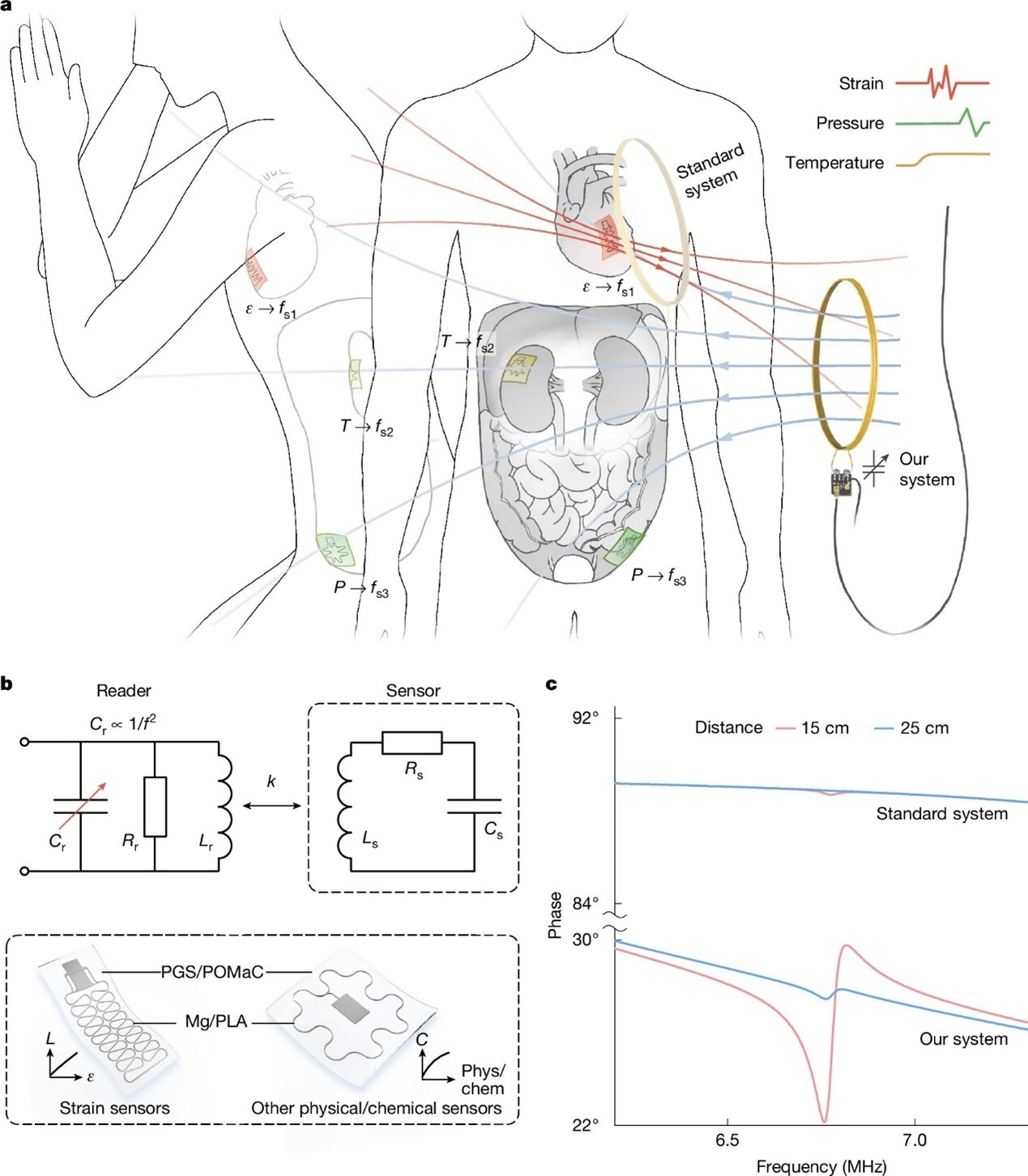
Fig. 1. System components of the wireless sensing platform and signal response. a, Soft, biodegradable, wireless sensing platform used in a clinical environment, where distance and angle cannot be controlled. b, Schematic of the reader and the sensors. c, Comparison of simulated phase–frequency.
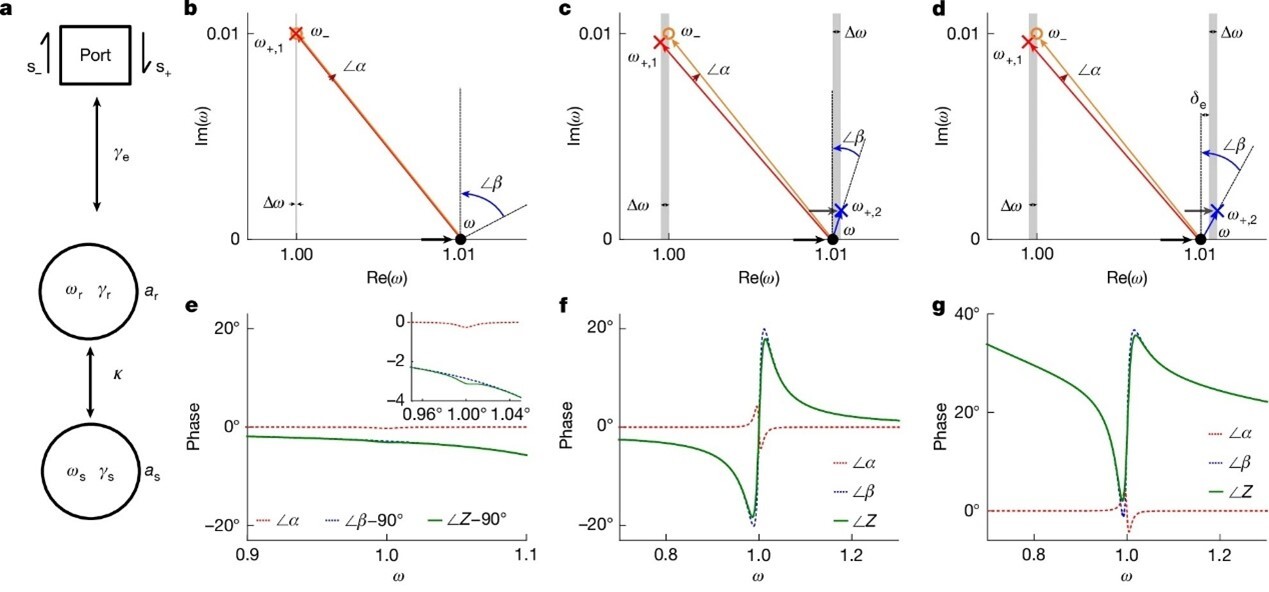
Fig. 2. Readout system of the wireless sensing platform. a, The system described by coupled-mode theory. b–g, The pole-zero plot and corresponding phase–frequency curves of different systems.
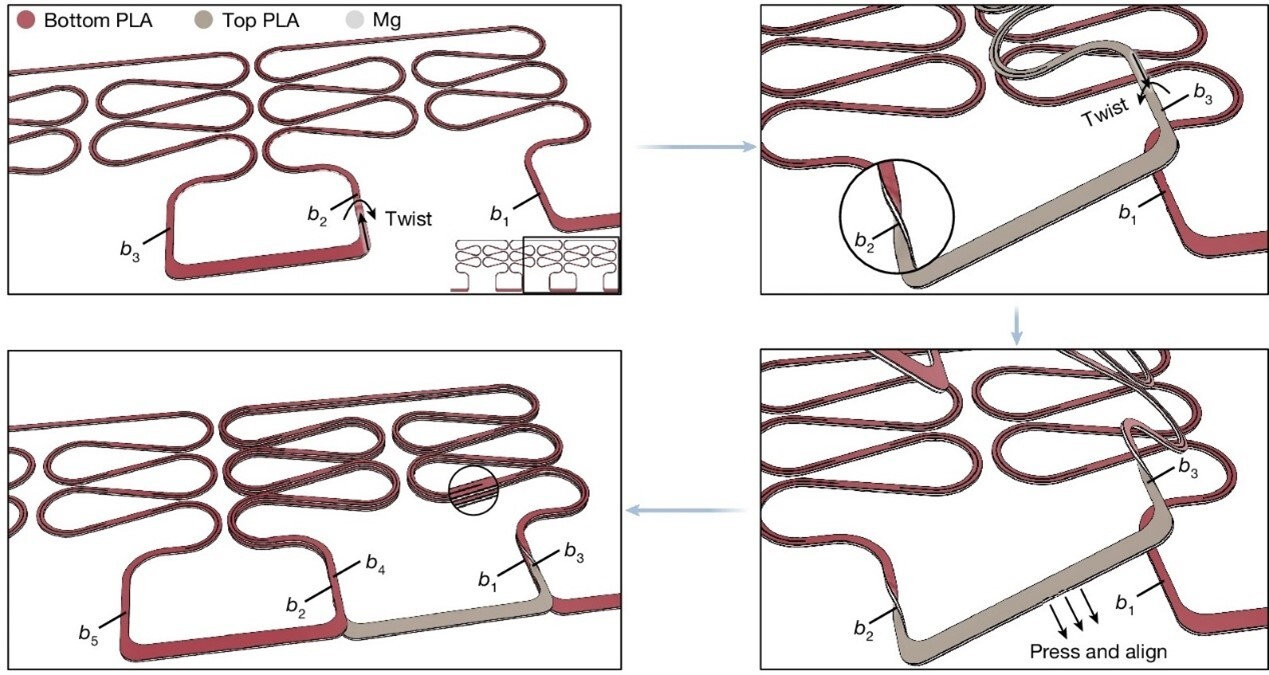
Fig. 3. An integrated folded structure design for the sensor.
Original link: https://doi.org/10.1038/s41586-025-09874-3
Contact:
ZHANG Ziao
Institute of Mechanics Chinese Academy of Sciences
Tel:86-010-82543676
E-mail:ziaozhang@imech.ac.cn
Web:http://www.imech.cas.cn/